
What Cannot Be Counted
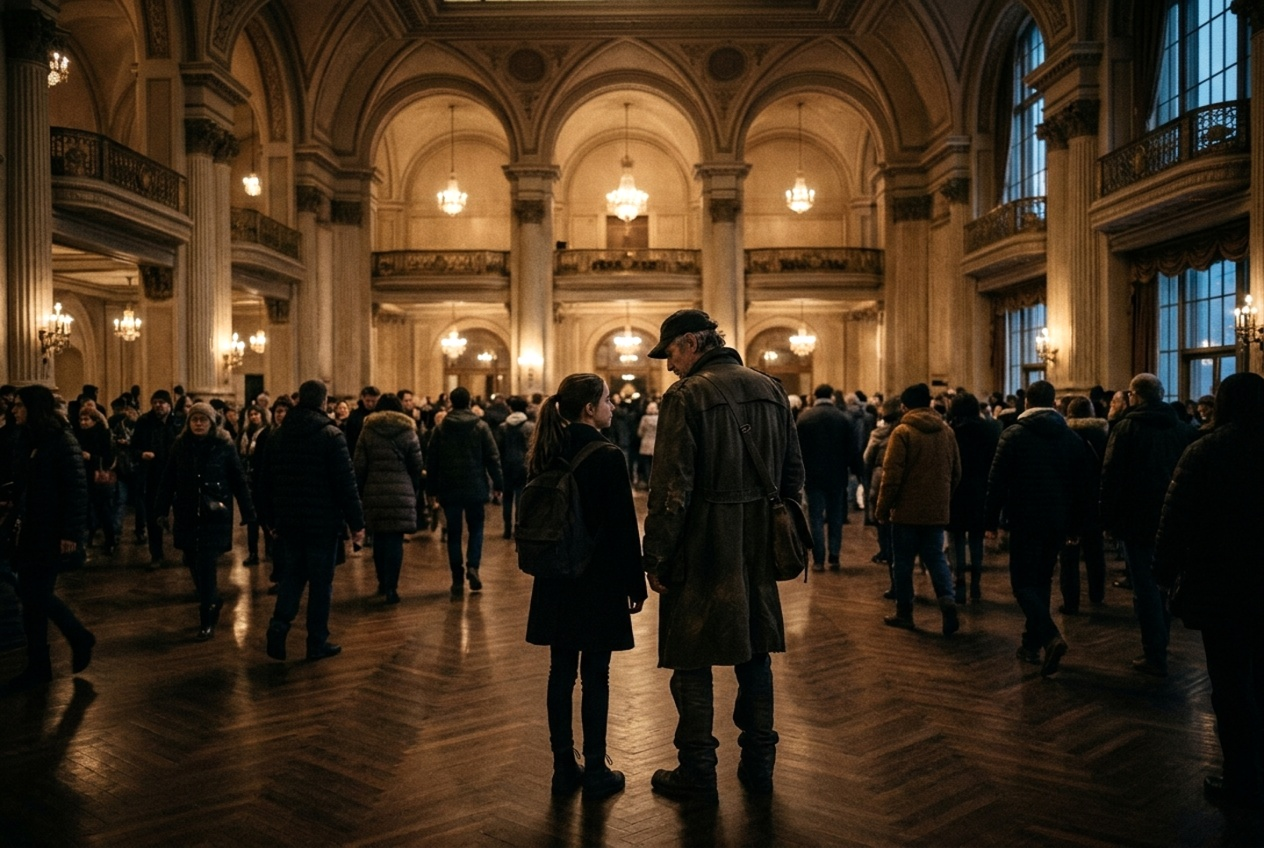
Imagine a city where survival is arithmetic. In near-future Montreal — after Quebec has separated and the economy has collapsed into recession — the Imperial Meridian Hotel on Sherbrooke Street has been reborn as the Ballroom, one of about a dozen gambling halls in the city. Every day, displaced people pay a ten-dollar entrance fee for a programmed tablet, then roam an enormous hall that stretches like a cathedral, trying to guess the exact number of players inside. When the officials hold one of their randomly timed counts, anyone whose guess matches the total wins the jackpot. A whole society's desperation, distilled to a single number.
At the center of this world are a father and a daughter. Bella is sixteen and left school after ninth grade to help her father. Walter is a Canadian Army veteran, scarred by Afghanistan; counting players in the Ballroom is the only work he could find after his discharge. "Here, Walter and Bella spent their days counting players who simultaneously counted them". Everyone in the hall is running the same estimate — counting the people who are counting them back. Human beings, reduced to units in a moving sum.
The game feels real, and not just as dystopian scenery, because its author actually knows the mathematics. Abraham Boyarsky is a novelist and a mathematician — for years Professor of Mathematics at Concordia University in Montreal, now retired from that professorship. When Walter explains his method, it reads like genuine estimation theory. He paces out a 400-square-foot zone — one-fiftieth of the 20,000-square-foot floor — counts the players inside it, multiplies by fifty, then refines. "It's about inference," Walter had once told Bella. "About knowing how people move when they're hungry. About subtracting the ones who ghost out. It's as much about what you don't see". The game, the book insists, is more than luck: it is pattern recognition, intuition, and much more.
But the novel's true subject is what refuses to be computed. Beneath the counting lies grief. Walter's war trauma follows him through the hall, and so does the memory of Elena — Bella's mother, an eighteen-year-old waitress when Walter met her in the Ballroom twenty years earlier, later lost to painkiller addiction and found lifeless in the kitchen by Bella. No estimate covers that. He lights a candle for his comrade Sam Dichter, killed by an IED in Afghanistan — a small ritual of remembering what the numbers erase. The love between Walter and Bella is the one thing in the book that cannot be reduced to a probability. "Don't let love become a cage," her mother said. "Not even your father's love". And when the Ballroom's owner tries to recruit Walter as an informant, Walter refuses — choosing instead to assemble a small team and try to beat the game on his own terms.
This is a dystopia that is really a question about value — what a person is worth when a system can only see them as a number to be guessed. The Ballroom is no decaying ruin; the floor is mopped three times a day, kept pristine because the place is still open for business. The horror is not in neglect but in how thoroughly order and counting have become the same thing. And still, a line of graffiti reminds the players that they will survive together — a promise the arithmetic cannot touch.
When have you been reduced to a number — and what in your life refused to be counted?